
Choose the comparison question
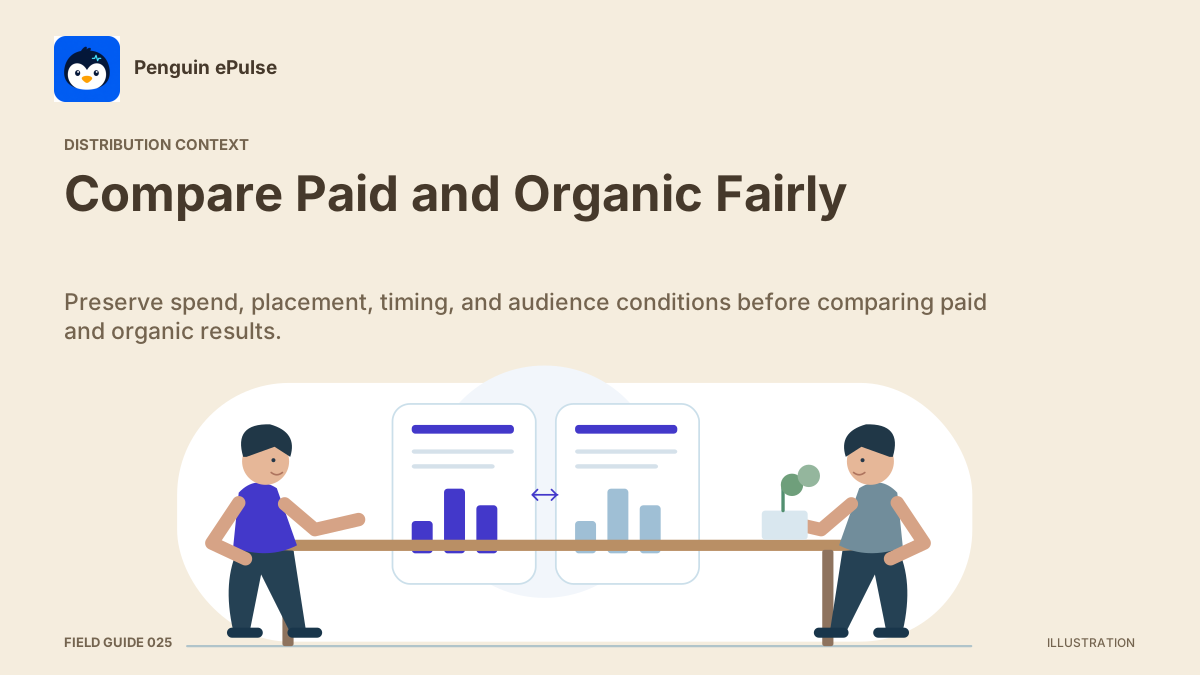
Paid vs organic social analytics requires separate distribution conditions even when the creative is shared. A comparison can ask which organic creative deserves a paid test, how promotion changes delivery, whether content serves an existing community, or how a campaign contributes to an observed outcome. Choose one question and specify audience, objective, and period before combining data. The question determines which fields are relevant.
Paid and organic distribution do not necessarily reach equivalent populations. Paid activity can have a selected objective, budget, placement, bid conditions, and optimization process. Organic content has a different delivery context. Larger paid totals do not prove stronger creative. Higher organic rates do not prove promotion is wasteful.
The LinkedIn Page content analytics definitions [2] note that boosted-post scope can differ from Campaign Manager. Paid vs. organic social media analytics should retain the reporting surface beside each total before choosing which evidence supports a spending decision.
Describe observable conditions and unobserved differences. If the audience changes substantially, the report should treat creative superiority as a hypothesis rather than a finding. A fair comparison is one whose interpretation respects selection, not simply one with two neatly aligned columns.
Keep promotion history with content objects
A post can begin organically and receive promotion later. Record the promotion start, creative relationship, campaign or ad identifiers when available, and field treatment of paid activity. Keep the original platform post distinct from ad delivery objects. A creative family can contain several objects with different targeting and dates.
Do not assume total equals paid plus organic unless documented definitions establish compatible components and overlap treatment. Unique audiences can overlap and surfaces can use different periods. Store available components with status and definitions. If one is unavailable, label the gap. Subtracting a number from another surface to manufacture organic performance can create an invalid calculation.
Preserve edited versions too. A caption or destination change after organic publication can make the paid test meaningfully different. The review should explain which creative and link were actually tested, rather than attributing all behavior to the first published version.
Build cohorts that fit the objective
For creative learning, compare similar topics, formats, audience stages, and observation ages. Separate promoted and unpromoted objects. Include optimization objective because an engagement-focused campaign and a traffic-focused campaign can produce different actions by design. Ignoring that goal may reward the wrong content for the next decision.
Show scale and efficiency together. A small organic audience can produce a high rate with limited evidence about broader performance. A paid campaign can deliver more relevant visits at a lower interaction rate. These results are compatible. Use the intended behavior as the primary measure and diagnostics to explain it.
Inspect cost and workload when relevant, while retaining source boundaries. Production cost belongs to the creative family and media spend to the paid delivery. Decide how shared costs are allocated before interpreting profitability. Changing the allocation after results arrive can make either program appear more efficient without changing actual activity.
Worked example: selecting a paid test
All numbers here are hypothetical. A comparison guide receives 80 interactions and 2,000 compatible impressions organically; a feature announcement receives 100 interactions and 5,000 impressions. Their impression-based rates are 4% and 2%. The guide also generates more tagged visits to a specification page in the website report.
The manager selects the guide for a limited traffic-focused paid test. This is a useful hypothesis about destination behavior, not a guarantee that its organic rate will persist. The test has its own audience, budget, window, and acceptance measure. Promotion history prevents its delivery from silently entering a later organic comparison.
After the test, the analyst examines verified destination behavior and relevant costs under the stated setup. More delivery without meaningful site activity prompts investigation of audience selection or message-to-destination fit. The lower paid interaction rate alone does not establish that organic “beat” paid.
The record also captures the landing-page version. If the page changed during the test, the team qualifies the result and plans a cleaner follow-up before assigning the difference to creative or distribution. Context matters as much as arithmetic.
McKinsey's full-funnel measurement guidance [3] discusses incrementality tests alongside marketing models. When this paid-versus-organic decision requires a causal estimate, ask the measurement owner to define an appropriate comparison design. A higher attributed total alone does not establish the extra benefit of buying distribution.
Separate attribution surfaces and impact claims
A platform can assign conversions under its rules while a website system records tagged visits and configured events under another setup. Do not add those totals as independent outcomes. Reconcile event definition, population, windows, and model. Show where each result comes from.
Google Analytics' attribution introduction [1] concerns assigning credit across observed paths. Attributed outcomes are not automatically estimates of incremental impact from paid or organic activity.
When a budget decision requires incrementality, plan a defensible experiment or other suitable causal method. Routine comparison can reveal operational differences and hypotheses, but selection remains a confounder. Stronger language needs stronger design.
Check outcome duplication with the business-record owner. One sale can appear in several reporting systems. Retain a reconciled commercial total and explain each attribution view separately. A larger sum of credited outcomes can reflect overlapping reporting rather than additional customers or revenue.
Apply a fair-comparison checklist
Also record which conclusion would be unsupported if promotion history were lost. This focuses QA on the decision's sensitive boundary. If the report cannot separate promoted and unpromoted objects, qualify its creative comparisons instead of presenting the merged total as organic evidence.
Check object relationships and paid history before ranking. Confirm compatible windows and preserve unavailable components. Inspect whether one promoted outlier drives the conclusion. Include raw counts beside rates so reviewers can judge evidence scale.
- State the decision and intended behavior.
- Separate creative families, posts, and ad objects.
- Record promotion timing, goal, audience, and budget.
- Verify component and total definitions.
- Keep attribution surfaces and duplicate outcomes visible.
- Assign a next test and review date.
- LinkedIn Page content analytics definitions [2]
Paid and organic programs can serve complementary purposes. Explain those purposes and measured behavior. Avoid a universal contest from unlike objectives or a claim about every audience's preference from selected delivery. The comparison is useful when it changes a concrete test or allocation with its uncertainty intact, and when the following review checks whether that action produced the intended result.
Frequently asked questions
Can paid be subtracted from total?
Only with compatible source definitions, periods, and overlap treatment. Do not manufacture an organic component from unrelated surfaces.
Does organic success guarantee paid success?
No. It can motivate a limited test, but audience, objectives, placements, and delivery change. Define the paid test independently.
Which number belongs in an executive report?
Use the measure tied to the decision, with costs and verified outcomes where relevant. Preserve paid context and distinguish attribution from incremental impact.
References and source scope
- Google Analytics attribution introduction
Google Analytics outcome-credit concepts; not proof of incremental campaign sales.
Source link checked 2026-10-03 - LinkedIn Page content analytics definitions
LinkedIn Page content metrics and sponsored scope; not a universal engagement definition.
Source link checked 2026-10-03 - McKinsey: Why every business needs a full-funnel marketing strategy
Linked marketing KPIs, media-mix measurement, attribution, and incrementality testing; historical strategy guidance, not a current ROI benchmark or proof of any campaign's impact.
Source link checked 2026-10-03