
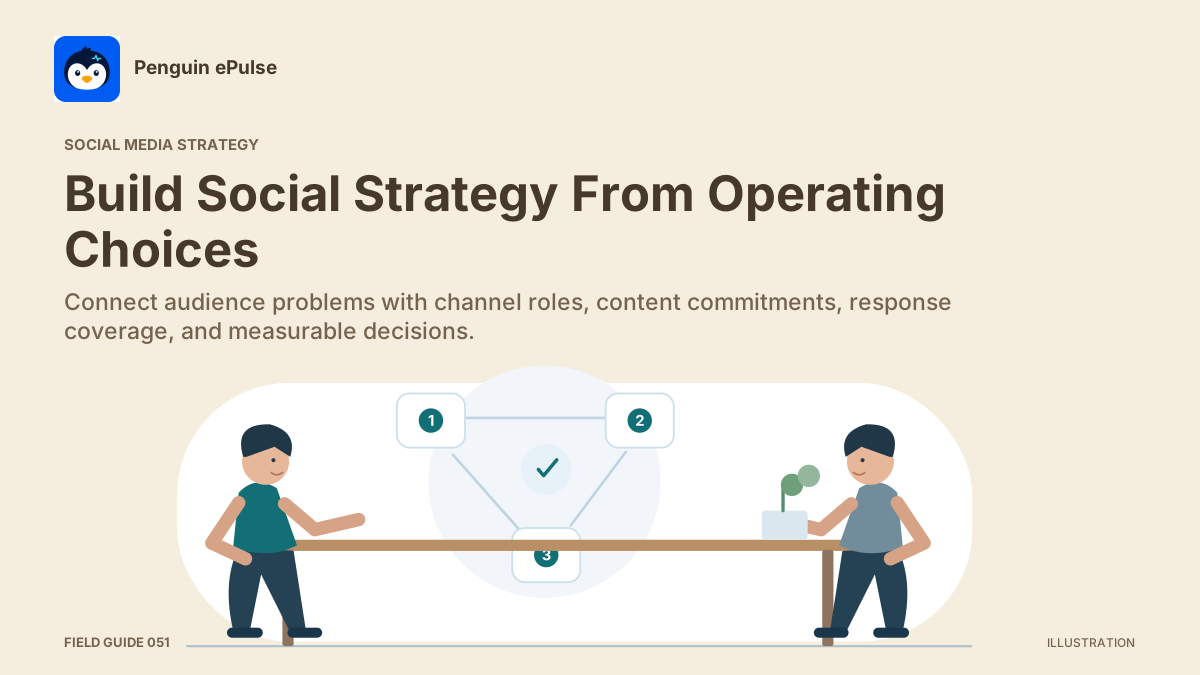
A social media marketing strategy connects an audience problem with channel roles, content commitments, response coverage and measurable decisions.
Social media management puts these choices into owned workflows, so the strategy should state which decisions operations can make without another approval.
A social media strategy is a set of operating choices about whom to serve, what useful relationship to build, and where to invest limited attention. It should explain why the team will do some work and decline other work. A publishing schedule cannot supply those choices by itself. Start with a business problem that social activity can plausibly help address, then connect audience needs, channel roles, content, community coverage, and measurement. The following method is a recommended planning framework, not a claim that one mix produces predictable growth. It turns a broad ambition into a program that someone can execute, challenge, and revise.
Define the problem and the audience moment
Write the business problem in language that does not assume the answer. “Prospective customers struggle to evaluate implementation effort” is more useful than “we need more video.” The first statement invites evidence about the obstacle; the second commits the team to a format before understanding it. Ask the customer-facing team which questions recur, which decisions stall, and what information people need to take the next step. Keep interview observations, service records, and assumptions separate. A strong anecdote can suggest a direction without proving that the entire market shares the concern.
Name the audience by its relevant situation. A job title may help targeting, but it does not explain whether someone is exploring a problem, comparing approaches, trying to implement a purchase, or seeking help after a failure. Choose one primary situation for the initial program. State what people should understand or be able to do after engaging with the content. This gives the creative team a practical brief and lets the community team recognize useful questions.
Define the boundary of the program as carefully as its purpose. If the strategy focuses on helping operations managers evaluate a service, it may deprioritize broad lifestyle content or unrelated hiring announcements in that channel. Those activities can still have other owners or channels. The strategic document should show the tradeoff, who approves it, and the conditions that could change it. An audience definition that includes everyone gives the team little help when resources become scarce.
Give each channel an explicit role
Assign channels according to the audience relationship they can support and the team's ability to operate them. One channel might introduce a practical problem, another might host detailed demonstrations, and another might handle service questions. Record a reason for each role using available audience evidence and actual access. Do not describe a channel as a conversion engine merely because competitors post there. A channel role is a hypothesis that needs review, especially when the organization has little history or incomplete measurement.
A channel plan also needs an accountable account owner. YouTube Help: channel permissions [2] documents distinct delegated roles. Check the actual role before assigning publishing or reporting work; these permissions do not establish whether the channel is right for the audience.
Describe the path between roles. A short post that raises a question should lead to an explanation people can actually use. A demonstration should identify an appropriate next step without forcing every viewer into a sales request. A service reply should route a customer to a supported help process. Check whether destinations work for the intended audience and whether the receiving team has capacity. A social plan can generate frustration if it creates inquiries that no one can handle.
Decide how much adaptation each channel deserves. Reusing the same message can be sensible, but copying the same asset, length, and call to action everywhere may ignore how the audience encounters it. Name the element that must remain consistent, such as an accurate explanation or a qualifying condition, and the elements that can change. Include a pause rule for an account that loses access, a destination that becomes unavailable, or a channel whose workload exceeds the agreed coverage. Presence alone is not a sufficient reason to continue publishing.
Choose the content and community work you can sustain
Create a small set of content commitments tied to the audience obstacle. For an implementation question, commitments might include a process walkthrough, a realistic preparation checklist, and an answer to a recurring misconception. Specify the evidence required for each commitment. Product details need confirmation from the responsible team; customer quotations need permission and context; numerical claims need a traceable source. An attractive concept should not bypass those requirements because the calendar contains an empty slot.
Plan community work as part of production. Identify who will watch replies, when they will be available, what they can answer, and where exceptions go. A post inviting questions creates work beyond asset creation. Estimate that work and include escalation coverage for subjects the social team cannot settle. Decide whether a launch needs a narrower publishing window so an informed responder is present. The strategy should align what the brand invites with the service it can provide.
Budget in work units rather than aspirations. Include research, writing, design, adaptation, approval, publishing checks, moderation, reporting, and revisions. Record the limiting skill or dependency. If every demonstration requires a specialist who is available once a month, the strategy cannot promise a weekly demonstration without changing that dependency. Leave capacity for urgent work and identify which routine commitment is reduced when that reserve is used. A sustainable plan has a visible way to absorb change instead of relying on unpaid overtime or rushed approval.
Build measurement around the operating choice
Select evidence that helps decide whether the chosen relationship is developing. Relevant questions, useful destination visits, qualified inquiries, successful help routes, or repeated participation may matter differently for different roles. Define each measure, its source, its observation period, and its limitations. Keep distribution measures separate from evidence of comprehension or action. A larger audience can be useful while still leaving the original obstacle unresolved.
For website journeys, Google Analytics documents custom campaign parameters [1] that can identify campaign traffic. Use a consistent naming convention and verify the landing experience, but do not treat a tagged visit as proof that social content caused a purchase. Record what can be observed, what requires another system, and what remains unattributed. If the business cares about qualified requests, agree on qualification with the receiving team before building the report.
Set a baseline from comparable available activity or label the first period as exploratory. Avoid inventing a target from an unrelated industry average. Decide what observation would justify continuing, changing, or investigating the program. Include execution evidence: whether planned material was released, whether replies received coverage, and whether the destination functioned. A strategy that was not executed cannot be evaluated as though it had failed its audience hypothesis. Review performance and delivery conditions together, while keeping their meanings distinct.
Make the strategy a revisable decision record
Write a concise strategy record containing the problem, primary audience situation, channel roles, content commitments, resource allocation, measures, and review conditions. Assign one person accountable for maintaining the record and identify who can approve a material change. Keep unresolved questions visible. The record should explain the plan well enough that a new writer or community manager can make routine choices without consulting a slide deck full of slogans.
Use two review rhythms. An operating review checks whether the work can proceed and resolves near-term blockers. A strategic review assesses whether the choices remain useful as evidence accumulates. Do not rebuild the strategy after every weak post, and do not preserve it indefinitely because leadership once approved it. Choose a review window suitable to the content cycle and audience decision. Identify earlier triggers, such as a major product change or an unsupported service promise, that require reconsideration before the scheduled review.
Record what the team will stop when it adds a new commitment. This protects a strategy from becoming a collection of all requests received during the quarter. A proposed new channel should identify its purpose, owner, access requirements, production cost, community cost, and the existing work displaced. If the proposal cannot name those conditions, treat it as a discovery task. The strategy remains useful when it governs resource choices and preserves the reasoning needed to revise them.
Give awareness and action their own evidence
McKinsey's full-funnel framework [3] connects brand building and performance marketing rather than evaluating every activity by one immediate response measure. In a social strategy, give discovery content, purchase support, and service distinct jobs. Define the evidence for each while keeping the overall business objective visible.
Resolve conflicting objectives before adding channels
Gartner's March 2025 survey release [4] describes strategic dysfunction arising from unclear or competing marketing objectives. Use that finding as context for an explicit priority discussion, not as a diagnosis of your team. Agree which audience problem the social plan serves and which competing requests it will defer.
Worked example: applying the method
Hypothetical planning example: a fictional maintenance software company wants to help operations managers evaluate onboarding effort. Its team has one writer, a designer available part time, and a product specialist available for a monthly recording session. It chooses one detailed monthly demonstration, two shorter explanations drawn from it, and a weekly answer to a verified implementation question. LinkedIn introduces the question; the demonstration destination carries the full conditions; the service team owns account-specific inquiries.
The company deliberately postpones a daily entertainment series because it would consume the designer's available time without addressing the chosen obstacle. Its measures include visits to the implementation guide, the relevance of questions, and inquiries assessed under the sales team's existing qualification definition. The team makes no revenue claim from those visits. After an illustrative eight-week review, it will check whether the promised sequence was delivered, whether responders handled the invited questions, and whether the audience still lacks a specific explanation. If specialist availability drops, it will reduce new demonstrations and improve the existing guide. These are invented planning conditions, not a case study, forecast, or reported result.
Practical checklist and limits
- Write one business problem and one primary audience situation.
- Assign each channel a role and a supported destination.
- Budget creation, approval, community coverage, and revisions together.
- Define measures and the evidence unavailable from social sources.
- Record a review window, early triggers, and what new work would displace.
Strategy remains uncertain because audience behavior, distribution, and business conditions change. Interviews and social comments represent observed participants rather than the entire market. Tagged journeys show recorded paths and may omit other influences. The framework cannot promise growth, qualified demand, or a particular return. Use it to make resource decisions visible, then test the assumptions with the evidence the organization can actually collect. Sensitive issues and material claims may require additional specialist review before any execution is approved.
Turn a social media marketing strategy into operating choices
A social media marketing strategy should identify the audience decision the program helps, the information people need, and the work the team can sustain. A social media strategy supplies those choices across content, conversations, and measurement. Neither a format preference nor a target posting frequency explains why the activity deserves attention.
Write a short decision record for the program: audience situation, useful promise, channel role, owner, available capacity, and evidence that would justify revision. If prospects repeatedly ask about implementation, explain a real implementation step and record the questions that remain. A hypothetical increase in comments would not prove that purchase confidence improved; use an appropriate outcome record or research method for that claim.
Frequently asked questions
How many channels should a strategy include?
Include the channels with a defined audience role, reliable access, and sustainable creation and response coverage. The number follows those conditions rather than a standard template.
How often should the strategy change?
Review it on a schedule suited to the audience and production cycle. Use explicit early triggers for material changes, and avoid treating one post as a verdict on the whole program.
Is follower growth a strategy goal?
It can be a supporting goal when the audience is relevant to the intended relationship. Pair it with evidence that people receive useful information or take the appropriate next step.
References and source scope
- Google Analytics: collect campaign data with custom URLs
Google Analytics custom campaign parameters and naming; supports tagged-traffic identification, not causal revenue attribution.
Source link checked 2026-10-03 - YouTube Help: channel permissions
YouTube delegated channel roles and documented limits, including API access; native permission behavior is source-specific.
Source link checked 2026-10-03 - McKinsey: Why every business needs a full-funnel marketing strategy
Connecting brand and performance measurement and recognizing differing business roles; not proof that a social metric caused an outcome.
Source link checked 2026-10-03 - Gartner: Marketing leaders challenged by unclear and conflicting objectives
Published survey discussion of unclear or conflicting marketing objectives; survey findings do not diagnose an individual organization.
Source link checked 2026-10-03