
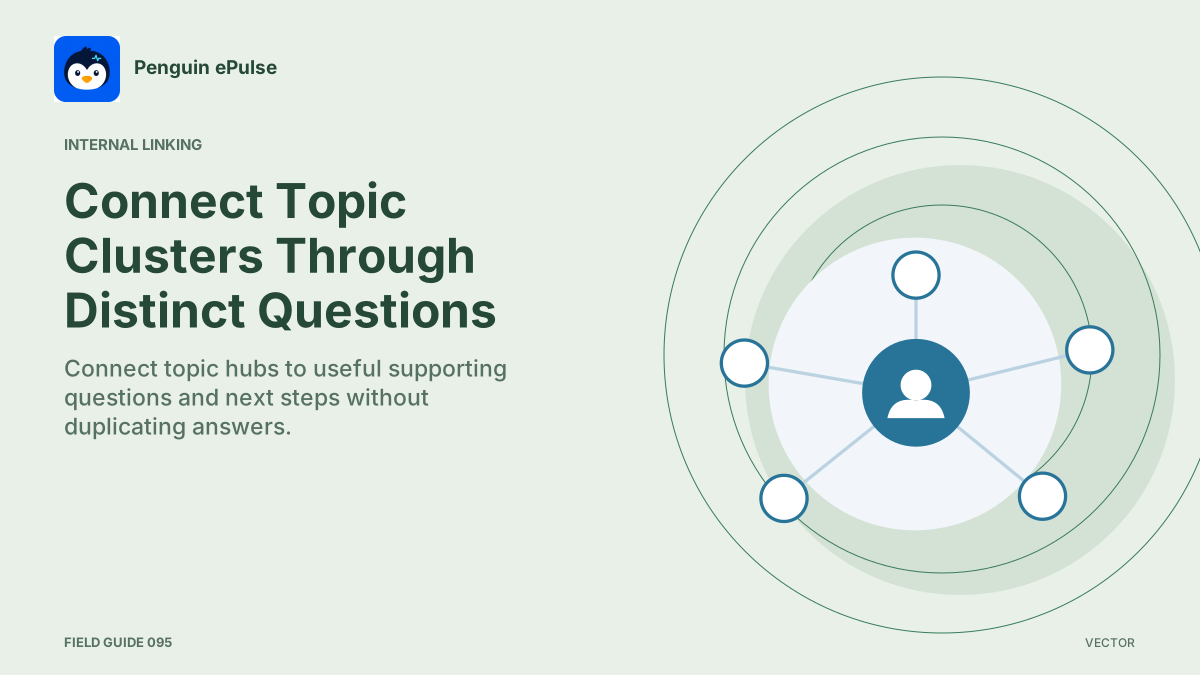
Topic cluster internal linking connects a broad hub with distinct supporting questions and useful next steps rather than duplicate pages.
A social media marketing topic hub should connect distinct questions about measurement, approvals and response handling without duplicating their answers.
Define the hub's job
A topic hub is an orientation page. It explains the subject, identifies the questions within it and points readers toward the resource that matches their next decision. A social analytics hub might distinguish metric definitions, calculation methods, reporting practices and attribution. It should help a visitor choose among those paths rather than repeat every article in miniature.
Start with a question map instead of a keyword tree. Keywords are useful research inputs, but slight wording differences do not automatically justify separate articles. "What is brand listening?" and "Brand listening explained" may represent the same question. "How do we remove irrelevant brand mentions?" requires a different method and can justify a separate supporting guide.
Give each supporting page a distinct role
For every planned article, record the primary question, reader, required input and final decision. A query design guide takes a brand vocabulary as input and helps produce a testable listening query. A coverage guide takes source requirements as input and helps assess which conclusions the available data supports. A sentiment guide takes a labeled sample as input and helps review interpretation quality.
The roles create natural links. Query design links to coverage when the reader needs to understand what a source can supply. Coverage links to reporting when explaining how to disclose missing inputs. Sentiment links to the underlying conversation review method. Each link should resolve a real dependency, not merely increase the number of internal links on the page.
Write descriptive anchors
Use link text that tells readers what they will find. "Review listening coverage limits" communicates more than "click here." Place the link where the supporting question arises. A list of related articles at the end can be useful, but it should not replace links within the explanation when a reader needs context to understand the current step.
Contextual links should name the next resource clearly. Google: Crawlable links [1] recommends crawlable anchor links and descriptive anchor text. Connect related tasks in ordinary HTML and avoid forcing every keyword variation into the link label.
Use ordinary accessible links that point to real pages. Check the final rendered site rather than assuming the authoring interface produces crawlable navigation. If a resource opens only through an onclick event or an internal preview selector, it may be less reliable for discovery and accessibility than a normal link with a destination.
Worked example: a reporting cluster
This is a hypothetical architecture exercise. A team plans six articles around social reporting: weekly updates, monthly reports, quarterly reviews, executive dashboards, metric definitions and reporting QA. The hub explains when each resource is useful. The weekly article focuses on immediate operating changes; the quarterly article focuses on a larger next investment. They should not use the same outline with only the reporting period changed.
The executive dashboard guide links to metric definitions when describing a rate. The reporting QA guide links to the data quality method when discussing missing observations. The quarterly review guide links to the executive dashboard for presentation choices and to the attribution guide when discussing inquiries. This path follows the work required to prepare a review.
Suppose the invented inventory also contains "quarterly social reporting guide" and "social quarterly reporting best practices," both covering the same audience, inputs and output. The editor should merge or reposition them before publication. A new URL is justified when the reader's decision changes, not when the phrase can be reversed. The surviving page can address both natural phrasings without repeating them mechanically.
Build a link inventory
Maintain a record with source page, destination page, anchor, reader purpose and review date. Use the reader-purpose field to challenge unnecessary links. A destination might be "metric dictionary," but the purpose should explain why that dictionary matters at that point, such as clarifying whether the report's engagement rate uses impressions or reach.
Review inbound links as well as outbound links. A well-written article that is reachable only from a sitemap can still be difficult for a visitor to discover. Give new articles a relevant hub placement and at least one contextual path from an existing resource when the relationship is legitimate. Avoid automatically linking every article to every other article in its cluster.
Use a practical cluster review checklist
- Can the hub explain the subject and direct a reader without becoming a duplicate of the pillar article?
- Does each article resolve a distinct question with a complete explanation?
- Do contextual links answer uncertainties that arise in the surrounding paragraph?
- Are anchors descriptive and destinations working on both desktop and mobile?
- Can a visitor reach each article through a useful browsing path?
- Have moved or merged articles been handled with a clear redirect and updated links?
During review, ask a colleague to solve a task using the library. Give them a scenario such as preparing a monthly client report with missing paid data. Observe which article they choose and where they become uncertain. The exercise evaluates the architecture as a working information system, rather than measuring its quality by link counts alone.
Avoid misleading cluster claims
An internal link does not prove expertise or guarantee a ranking improvement. A cluster can make a useful body of work easier to navigate, but the supporting articles still need evidence, review and distinct value. Linking several thin pages together does not resolve their lack of substance.
A cluster still needs a clear URL for each distinct resource. Google: Canonical URLs [2] explains signals for duplicate or similar pages. If two drafts answer the same question, resolve their purpose before using internal links to make them look like separate topics.
Likewise, a hub label should match the actual library. Do not call a collection "complete" if it omits material platform limitations or required inputs. Show the scope and keep unfinished drafts out of the public resource navigation until they have passed the agreed editorial review. A smaller coherent cluster is more useful to a reader than a larger collection of overlapping promises.
Frequently asked questions
How many articles should a cluster contain?
Use the number needed to address distinct audience questions. There is no useful universal target. An expanding product or workflow may create new questions, while a narrow subject may need only a few resources.
Should every article link to the product page?
Link when the product page supplies a relevant next step and its claims are verified. A product link should not interrupt an explanation merely to satisfy a fixed link quota.
Can two pages target similar phrases?
Yes, when they serve meaningfully different decisions. Review their audience, inputs and conclusions to ensure the distinction exists in the body rather than only in the title.
Are related-article cards enough?
Cards are useful browsing aids. Contextual links remain valuable when a reader needs another explanation at a specific point in the article.
References and source scope
- Google: Crawlable links
Google crawlable anchor links and descriptive, natural anchor text; keyword stuffing is not recommended.
Source link checked 2026-10-03 - Google: Canonical URLs
Google canonicalization signals for duplicate or similar URLs; does not make overlapping article intent distinct.
Source link checked 2026-10-03