
Write for a listener who has not read your brief
The host knows the project; the listener does not. Open by stating the question and why it matters now. Introduce each guest with only the context needed to understand their perspective. Avoid a long corporate biography that postpones the actual answer. The first minute should make a fair promise about the episode's scope.
Spotify for Creators describes a podcast script as a flexible outline. That is a useful default for an interview: it gives the conversation direction without prewriting a guest's answer. A solo explainer may need fuller wording for definitions or legally sensitive statements.
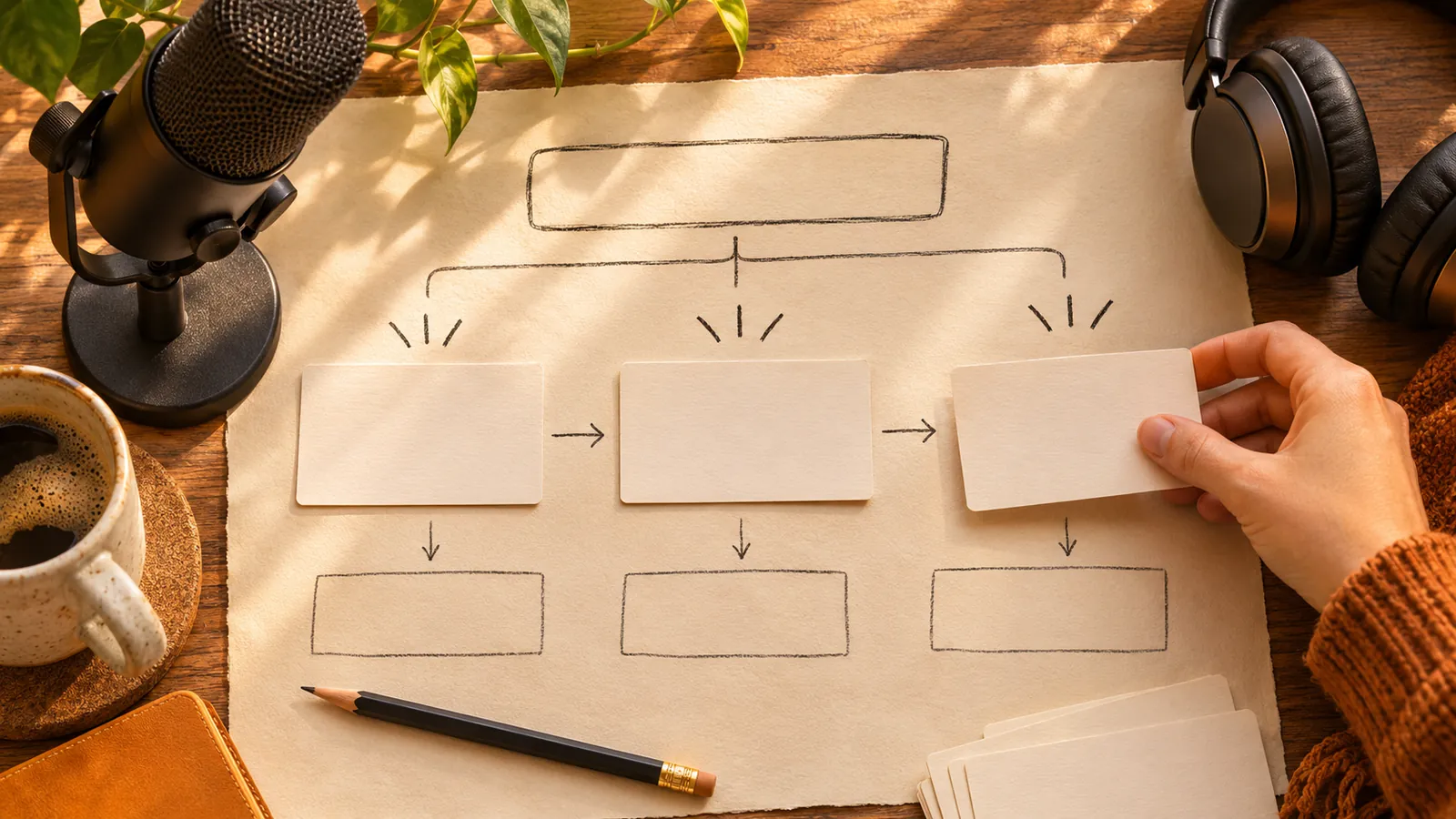
Build the episode in beats
Use five or six beats: the question, context, first evidence, complication, practical implication and close. Under each beat, write the one point the listener needs and the source that supports it. If a segment does not move the question forward, cut it or make it a separate episode. Leave a placeholder for the natural follow-up you cannot anticipate until recording.
Use prompts that invite explanation
“What happened?” is often less useful than “What changed the decision?” Ask for a concrete example, then ask what could make that example misleading. For a customer-facing topic, avoid presenting one person's experience as a universal result. For a regulated topic, have the qualified reviewer identify claims that require precise language or should be omitted.
Keep a production copy and a source copy
The production copy includes cues: timing, sound, guest handoff and pronunciation. The source copy holds links and fact-check notes. Separating them keeps the spoken script readable while preserving the evidence trail. Spotify's production guide discusses researching, preparing guests and shaping a narrative before recording. That preparation matters more than trying to repair an unsupported claim in postproduction.
For the closing, write one clear takeaway and one honest next action. If the episode leaves a question unresolved, say so. Do not use a call to action that implies the guest endorsed a product unless they did and that endorsement can be used.
Review the outline after the recording
A good interview may answer a different question from the one in the original brief. Listen to the edit before finalizing the title and description. Spotify's episode-description advice favors a concise description that reflects what listeners will actually hear. Check quoted lines against the recording, preserve context in clips and obtain any needed approvals.
For teams evaluating Penguin ePulse, the Podcast Studio can help prepare and review source-based drafts. It is not a substitute for an editor, expert reviewer, consent process, recording environment or publishing destination.
Put uncertainty in the outline
Mark statements as confirmed, needs source, expert interpretation or audience question. This is especially useful when an interview touches a changing product, policy or market statistic. The host can ask the guest to explain a claim while the editor knows it still requires verification before release. If an answer remains uncertain, an honest follow-up question can be more valuable than an invented transition to the next segment.
Time the outline after one rehearsal rather than assigning precise durations from a blank page. A five-minute explanation may take much longer when a listener needs definitions. Keep the sections that earn their place in the story and remove the material that exists only because it took effort to research. The final recording, not the first outline, determines the finished title.
Pressure-test the outline before recording
Read it aloud as a listener would
Read the first minute without looking at the research packet. Can a new listener tell why the topic matters, what question the episode will answer and who is qualified to answer it? If the opening depends on an acronym or a company story that has not been introduced, rewrite it. A clear outline can still sound conversational: use prompts and transitions instead of scripting every sentence.
For an interview on reputation response, the central beat might be a real decision: when a public complaint names a patient, customer or employee, what belongs in a public reply and what must move to a private channel? The next beats should test the boundaries of that answer: a missing fact, an angry reply, and a case where the organization made a mistake. These examples expose more useful reasoning than a broad request for 'best practices.'
Mark evidence and uncertainty in the same document
Next to each factual claim, add its source or an explicit 'verify before release' tag. Mark personal experience as experience, not industry data. Give the host a follow-up question for claims that sound overly neat: what failed, what changed the decision, or when would the advice not apply? The outline then becomes a safety tool as well as a pacing tool.
After recording, use the outline as a map, not a transcript. Strike segments that did not happen; add what the guest actually said; verify examples again before writing show notes. Note any promised resource or follow-up so it is not lost during editing. This keeps the published summary faithful to the episode and makes it easier to build a related article without presenting an unspoken point as a quotation.
Adapt the outline to the recording format
Interview: build a question ladder
For an interview, start with a situation the guest has actually faced. Ask what decision they made, what evidence they used and what could have changed their choice. Follow with a boundary question: when would this approach be wrong? Place follow-up prompts beneath each major beat, not a paragraph of scripted host language. This gives the host room to listen while preserving the episode's argument. Mark any source or number that needs verification before publication.
A possible sequence for a social listening interview is: define the decision, describe the initial signal, show how sources were checked, explain the resulting action, and revisit what the team learned. If the guest cannot share confidential examples, prepare a hypothetical scenario and label it as such. Never ask the editor to make the hypothetical sound like an actual customer story.
Solo: write transitions without flattening the voice
A solo episode usually needs tighter wording at the opening, at a complex explanation and at the close. Write those parts in complete sentences if precision matters. Between them, use bullet prompts with an example and a source. Record a rehearsal and listen for places where a listener would need a definition or pause. Add a signpost before changing from the problem to the method, and another before the limitations.
Time the beats, but treat durations as guides. If a five-minute example requires eight minutes to be understandable, trim a less useful section instead of rushing the evidence. After recording, the editor should mark where the actual conversation departed from the outline. The public description must reflect the final audio. Penguin ePulse's private pilot can help prepare and review source-based drafts; a human still decides what to say, records it and approves release.
Questions teams ask
Should a podcast script be written word for word?
Only when the material requires exact wording or the format calls for a narrated script. Interviews usually benefit from a structured question and evidence outline.
What belongs in podcast show notes?
A specific summary, guest details where relevant, source links and a clear next action. The notes should describe the finished episode, not the planned one.
How detailed should an interview outline be?
Write the opening question, major beats, follow-up prompts, source notes and a closing takeaway. Avoid scripting guest answers or every host sentence.
What if the recording produces a better story than the outline?
Use the recording as the source of truth, verify the new claims and update the title, description and show notes to match the finished episode.
More questions
What is a podcast script outline?
A sequence of listener questions, evidence, segments, interview prompts, transitions and production cues that guides the episode without prescribing every answer.
When should the outline change?
Revise it during research and again after recording if the finished conversation has a different but supported emphasis.
Put the guide to work.
Interview beat sheet
Download the editable worksheet. It includes two illustrative examples and blank planning rows. Replace the examples with your own verified information.
Download the worksheet (CSV)References and source scope
- How to write podcast scripts
Flexible script components for interview and solo formats.
Spotify for Creators · Checked 2026-11-03 · Public source material. - Podcast production: Tips for every stage
Research, guest preparation and narrative structure.
Spotify for Creators · Checked 2026-11-03 · Public source material. - How to write episode descriptions
Concise and accurate final descriptions.
Spotify for Creators · Checked 2026-11-03 · Public source material.
Continue with a related decision.
- Podcast Advertising: Plan Host Fit, Creative and Attribution
- Social Media Calendar: Readiness, Approvals, and Publication
- Original Content Evidence: Add a Useful Method, Not a Fabricated Case Study
- Social Media Scheduling Without Losing Editorial Control
- Make a Social Media Marketing Strategy Survive Monday Morning