
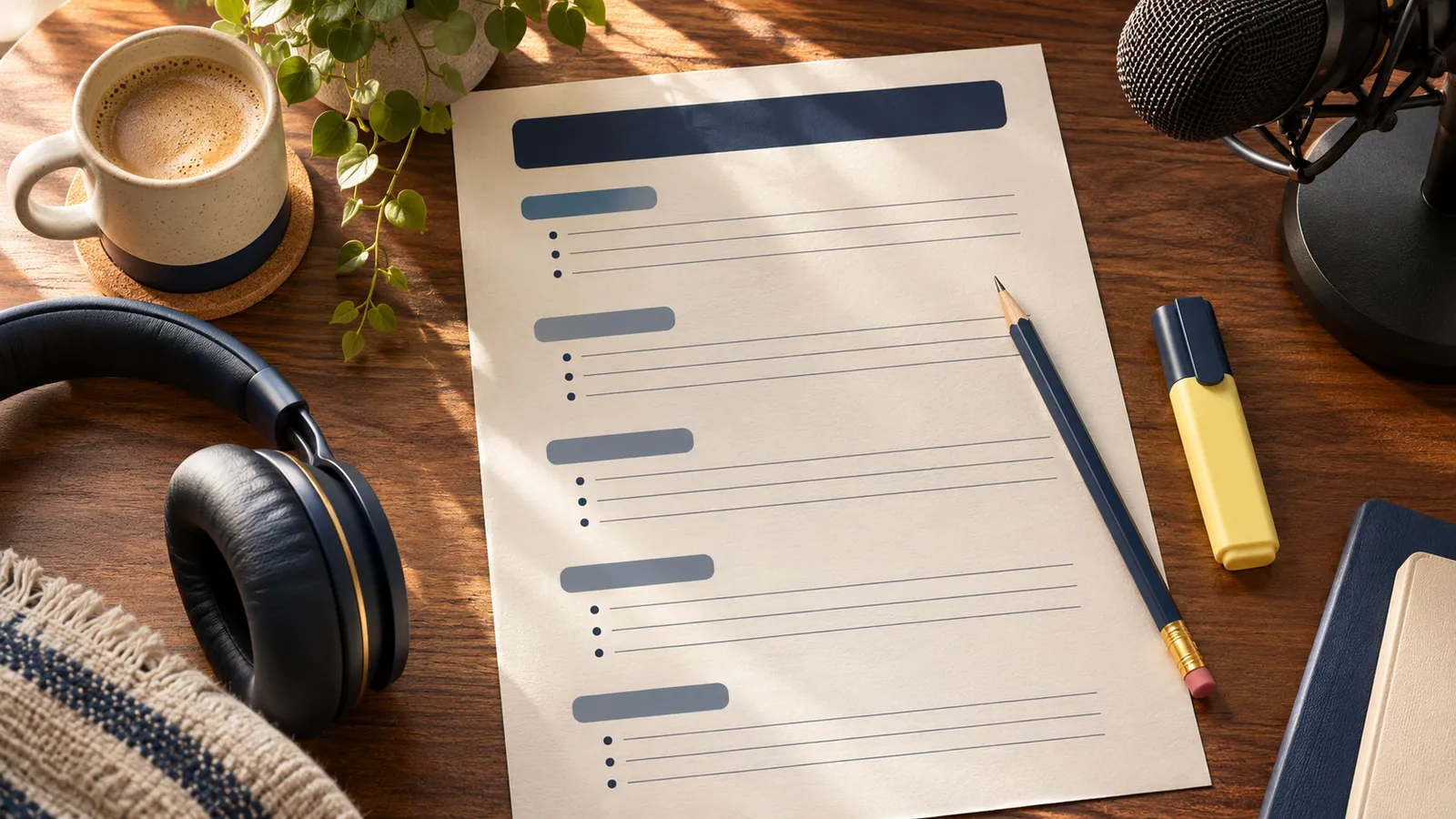
A podcast script template should guide a conversation: listener question, opening tension, evidence prompts, complication and a useful closing. Write exact lines only where accuracy or disclosure requires them; leave room for the expert to speak naturally.
Start with the listener's question
A script built from talking points often sounds like a company presentation. Put the actual question at the top: what will the listener know or be able to decide by the end? Then write an opening that earns attention by naming the tension, not by reciting a slogan. If the question is about choosing a platform, the first minute might explain the trade-off the buyer keeps encountering. Keep the intended audience and episode objective in the brief so a reviewer can identify tangents.
Use a five-part conversation map
One flexible structure is: opening question, context, evidence, disagreement or complication, and next step. Each part should have a purpose, an estimated time and a note about who owns the claim. The map is stronger than a fully written host speech because it allows the expert to sound like a person. Write exact language for essential disclaimers, sponsor identification, definitions and the closing call to action. Leave follow-up questions open enough to respond to an unexpected answer.
Mark claims before recording
Highlight any statistic, health or financial statement, customer story, product capability or competitive claim requiring source or permission. Put the source next to the line, not in a separate folder no one opens. A host should be able to ask, 'Where did this number come from?' before pressing record. Google's people-first content guidance asks creators to make expertise and authorship clear; the same discipline improves an episode's trustworthiness even when search is not the main channel.
Write for the ear
A paragraph that reads well on a page may be difficult to follow aloud. Use one idea per sentence, short introductions before unfamiliar terms and occasional signposts that remind listeners where the conversation is heading. Read the draft out loud and cut lines that require a second listen. Replace jargon where it conceals the point, but retain technical terms when they are necessary. Ask the guest to correct the framing before the recording rather than surprising them with a scripted conclusion.
Prepare the handoff to production
The script should travel with pronunciation notes, guest names and titles, rights notes, the planned episode description, and an indication of what may be cut. Spotify's episode workflow asks for title and description at publishing time; drafting them early can expose a script that lacks a coherent promise. After recording, compare the actual conversation to the prepared source list. Remove claims the evidence does not support and update the description to reflect the released audio.
Know which voice is speaking
A script drafted in Penguin ePulse Podcast Studio can organize approved material and suggest a voice map within your workspace allowance. The host still needs to decide which words express their own experience and which require attribution to a source. A synthetic or drafted voice should not be presented as an interview that never happened. After the final recording, compare quotations and disclosures with the script, then publish through a separately verified host. The AI workflow overview describes the assisted creation area, not access to every Editorial Desk workflow.
A usable opening and interview script
Write an opening with three lines: “Today we are answering [specific listener question].” “The decision is difficult because [real trade-off].” “By the end, you should know [practical test or next step].” Then move into prompts rather than speeches: “What did you observe first?”, “Which evidence changed your view?”, “Where would this advice fail?” and “What should someone check before trying it?” Put a source or verification note beside every planned number. This gives a host enough structure to protect the episode without flattening the guest's voice.
Host read-through
Read the opening aloud. If it sounds like an advertisement rather than a listener problem, revise it before recording.
Write the exit before recording
Close with a short synthesis: the answer, a qualification, and one action the listener can take. Draft the show-note link and episode description at the same time. If the script cannot name a useful next step, the episode question may still be too broad. Mark sponsor disclosures, sensitive examples and pronunciations as exact-read lines. Everything else can remain conversational. During the edit, check whether the final audio still answers the opening promise; rewrite the notes if it does not.
Template: a six-minute solo answer
For a short episode, allocate roughly one minute to the listener question and why it matters, two minutes to the evidence, one minute to a counterexample, one minute to a decision method, and the remaining time to a recap and source route. These are planning proportions, not rules. Put the exact source citation in the host notes beside the claim it supports. Use plain transitions: “Here is where the advice gets harder,” or “This condition changes the answer.” When the draft reads like a blog post spoken aloud, mark the sentences no one would naturally say and convert them into prompts.
Review the script against the final recording
After recording, highlight what the expert actually said. Did they revise a number, qualify an assertion or introduce an example that changes the episode's center? The final description should follow the approved recording, not the first outline. Check that music, sponsor mentions and guest introductions have the necessary rights and disclosures. If the best answer arrives late, edit for clarity but keep the conditions that made it accurate. A script is a map for the conversation; the public artifact is the edited audio and its supporting notes.
Make the script usable in an interview
For an expert interview, the host should not read a long question that contains the answer. Put the audience's decision at the top of the page, then write one open question and two probes for each segment. For example: “What evidence did you use?”, “What would change your view?” and “What do teams usually overlook?” Keep a margin for the guest's unexpected example. If the expert's response introduces a new claim, the editor can mark it for verification without interrupting every sentence. The script should help the host listen rather than push the guest through a prewritten promotion.
For a narrated episode, a fuller script can make sense. Still test the language aloud. Break sentences where a speaker needs to breathe, spell out acronyms on first mention and replace dense lists with one example. Put citations in production notes rather than forcing the speaker to read long URLs. If a line mentions a feature, identify whether it is live, limited or proposed. These small changes make a script safer and easier to hear.
Distinguish draft approval from performance
A script can be approved for factual accuracy and still sound flat when recorded. Make one rehearsal recording with the actual host. Note where they stumble, where the listener needs an example and where a transition hides a caveat. Rework the script, then compare the final cut against the approved claim table. If the speaker departed from an exact disclosure or made a new factual assertion, send that passage back for review. The public title and description should summarize what survived editing. Neither a well-structured template nor a saved audio draft proves that the episode has been published or heard.
More questions
Should a podcast script include every word?
Only when the format needs it, such as a narrated explainer or required disclosure. Interviews usually work better with a structured question map and sourced claims.
How long should a podcast script be?
Set length from the listener question and format. Time a read-through or pilot; there is no universal word count that makes an episode useful.
Can AI write a finished podcast script without review?
It can help draft a structure, but a human should verify facts, rights, tone and whether the words represent the speaker's actual view.
What if a guest introduces a number that is not in the script?
Mark the passage for review, locate the original source and confirm the definition and time period. Remove or qualify the number before release if it cannot be verified.
Put the guide to work.
Podcast script review sheet
Download the editable worksheet. It includes two illustrative examples and blank planning rows. Replace the examples with your own verified information.
Download the worksheet (CSV)References and source scope
- Creating helpful, reliable, people-first content
People-first content and transparent authorship guidance.
Google Search Central · Checked 2026-11-03 · Public source material. - Publishing audio episodes in Spotify for Creators
Current audio upload, metadata, verification and scheduling flow.
Spotify · Checked 2026-11-03 · Public source material.