
Retail · Market Listening
Turn retail product feedback into a researchable question
Retail social listening examines product and shopping questions within a defined collection of sources. Penguin ePulse Market Listening supports source-linked briefs that help teams review themes and their context. Separate product-use feedback, delivery experiences and campaign reactions before proposing a merchandising or content change based on the evidence.

Illustrative industry scenes · Anonymous workflows, not customer stories.
Illustrative example · Retail
Retail social listening, made visible.
Separate a recurring theme from a claim that needs stronger evidence. Switch the sample period to see the counts and the mix together.
Source-linked research over time
Weekly counts · 6-week example
Select a chart point to inspect the sample counts.
Example mix
Categories in the illustrative sample
View the 6-week example data
| Week | Source items sampled | Traceable items |
|---|---|---|
| 1 | 40 | 27 |
| 2 | 49 | 35 |
| 3 | 45 | 34 |
| 4 | 54 | 43 |
| 5 | 50 | 34 |
| 6 | 59 | 42 |
Source-linked research over time
Weekly counts · 12-week example
Select a chart point to inspect the sample counts.
Example mix
Categories in the illustrative sample
View the 12-week example data
| Week | Source items sampled | Traceable items |
|---|---|---|
| 1 | 40 | 27 |
| 2 | 49 | 35 |
| 3 | 45 | 34 |
| 4 | 54 | 43 |
| 5 | 50 | 34 |
| 6 | 59 | 42 |
| 7 | 55 | 42 |
| 8 | 51 | 41 |
| 9 | 60 | 41 |
| 10 | 56 | 40 |
| 11 | 65 | 49 |
| 12 | 61 | 49 |
Illustrative example numbers, not measured Penguin ePulse performance or customer results. Replace these with your approved records when evaluating the workflow.
Showing 6 weeks of illustrative example data.
The situation your team needs to change.
A retailer sees discussion about sizing around a new collection. Some comments concern fit, others mention unclear measurements, and several refer to an older product. The merchandising team needs to know which question it should investigate rather than treating every negative mention as the same product problem.
Mixed feedback is reduced to a sentiment label with no clear product or service owner.
A source-linked brief separates item-specific questions, service context and proposals for further investigation.
How to approach retail social listening.
Define the item and decision
Choose the product family, market, period and available sources. State whether the research concerns fit information, product use or a shopping experience. Keep delivery complaints separate from product characteristics and distinguish current items from older or similarly named products.
Review relevant examples in context
Follow the source links behind major themes and check a sample for false matches or duplicates. Do not treat copied posts as independent experiences. Retain uncertainty about whether a statement comes from an actual purchaser unless there is supporting evidence.
Brief the merchandising or content owner
Propose a clearer measurement guide, product explanation or further product investigation. Specify the evidence supporting that proposal and what is missing. Use appropriate commerce or returns research to assess purchase-wide effects rather than extrapolating them from social discussion.
Inside the workspace
The product behind the workflow.
Connect the operating question to the relevant Penguin ePulse features. Use your own account and sources to evaluate the next step.
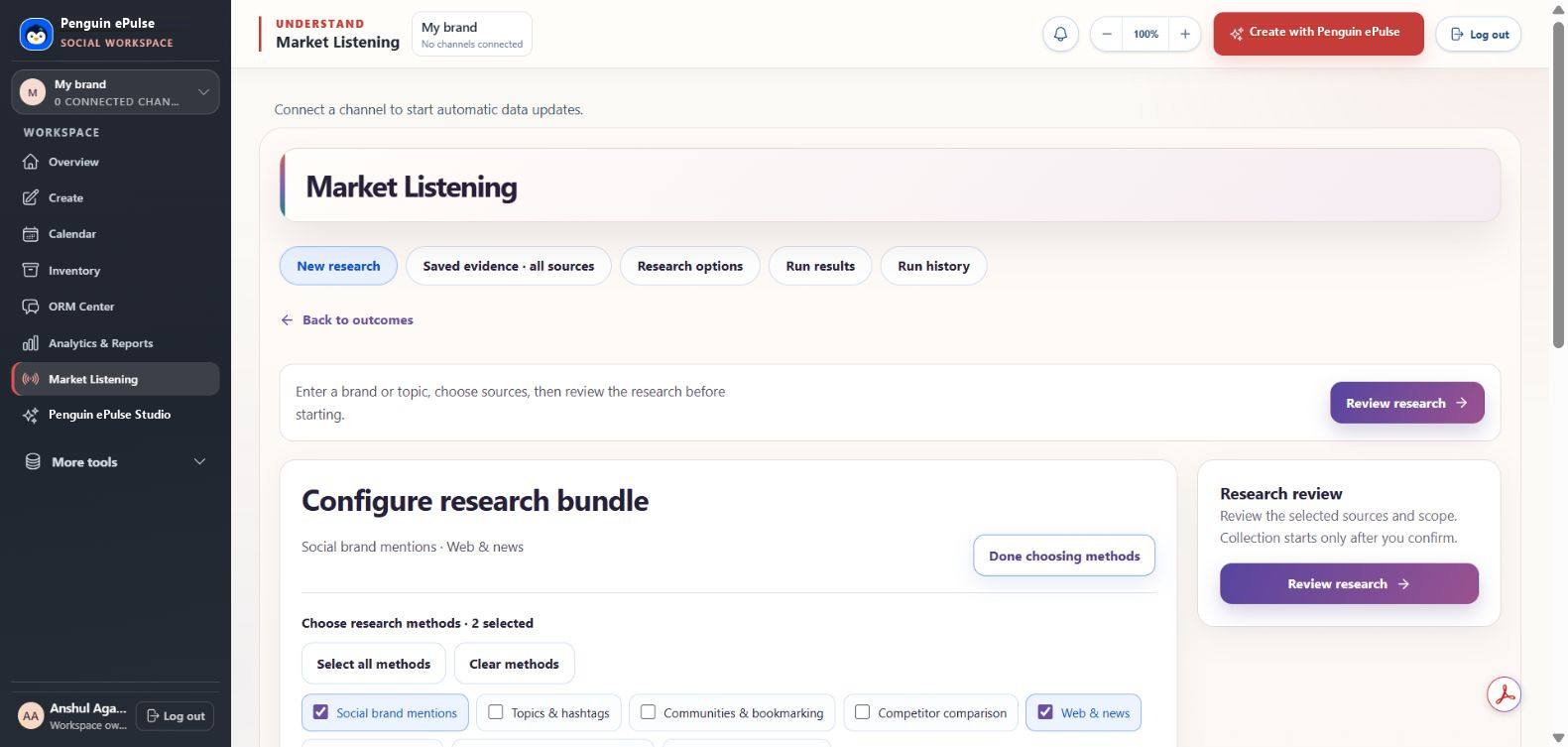
Where the Penguin ePulse features fit.
| Product surface | Role in this workflow |
|---|---|
| Market Listening | Build a scoped research brief and follow source links behind important findings. |
| AI Studio | Develop a working draft or explanation from available workspace context, with human review of the next action. |
| Create and Inventory | Prepare channel-specific drafts and keep working assets close to the content task. |
| Data Intelligence | Review configured research sources, collection scope and traceable records. Provider readiness and approved access determine available collection; source coverage is not exhaustive. |
Confirm the exact connected accounts, available actions and data before rollout. Research coverage depends on configured sources and provider access; some collection can carry provider costs. Human review and specialist handoffs follow your team's process.
Market Listening · Data Intelligence
Retail shopper and product intelligence
Define the product category, market and feedback question in Market Listening. Review available product, website or public social evidence in Data Intelligence. Separate product usability, delivery and return themes, then give the merchandise or service owner an evidence-linked change to investigate.
- Frame the decision. Define the audience question, entities, geography and dates before collection.
- Review available evidence. Check configured sources and provider readiness, retain source links and remove duplicates or unrelated records.
- Make a reviewable decision. Separate observed patterns from interpretation, retain coverage limits and assign a clear next action.
Collection depends on configured sources, valid provider access and approved scope. Some research uses paid providers; confirm access and costs before a run. These examples do not promise complete market coverage or automatic collection.
Explore Market Listening and Data Intelligence →Measure the decision, not just the activity.
| Measure to review | What the evidence should show |
|---|---|
| Relevant product matches | Review a sample for the intended item, market and period. |
| Distinct information themes | Separate product use, shopping service and campaign feedback with inspectable source examples. |
| Actions evaluated | Record which product-page, content or merchandising proposal receives an owner and further review. |
Set your baseline from a comparable period and record the source for each measure. These are evaluation criteria, not measured Penguin ePulse customer results. Use approved external records when the business outcome sits outside the social workspace.
Questions about retail social listening
How do Market Listening and Data Intelligence fit this workflow?
Define the product category, market and feedback question in Market Listening. Review available product, website or public social evidence in Data Intelligence. Separate product usability, delivery and return themes, then give the merchandise or service owner an evidence-linked change to investigate. Available collection depends on configured sources, valid provider access and approved scope.
Can social listening estimate the product return rate?
No. Return rates require appropriate transaction and return records. Conversation research can identify questions to investigate.
Does this analyze every retail review platform?
No exhaustive source coverage is claimed. Verify the particular sources, dates and collection access in the demo.
How should product and delivery feedback be separated?
Review the original statement and assign the theme according to the actual problem, retaining mixed or uncertain cases for human review.
Sources and operating boundaries.
Keep orders, payment information and identity verification in approved commerce and support systems. Social engagement is not a substitute for sales, stock or return records.
- FTC: social endorsement disclosures — Guidance on disclosing relevant relationships in social endorsements.
External references support the information-handling or measurement context. They do not certify Penguin ePulse or independently verify its product capabilities.
Go deeper on the operating decisions.
More retail use cases.



See this workflow with your team's context.
Bring an anonymized example and the account or research source you need. Walk through the source, the next action and the review afterward. The demo should establish which parts fit your current setup and which require another system or specialist.