
Automobile · Market Listening
Find owner-experience questions worth investigating
Automotive social listening examines ownership questions within an explicit set of sources, models and dates. Penguin ePulse Market Listening can organize a source-linked brief. Separate feature misunderstandings, service complaints and potential specialist concerns, then investigate supported themes without treating online conversation frequency as a vehicle defect rate.

Illustrative industry scenes · Anonymous workflows, not customer stories.
Illustrative example · Automobile
Automotive social listening, made visible.
Separate a recurring theme from a claim that needs stronger evidence. Switch the sample period to see the counts and the mix together.
Source-linked research over time
Weekly counts · 6-week example
Select a chart point to inspect the sample counts.
Example mix
Categories in the illustrative sample
View the 6-week example data
| Week | Source items sampled | Traceable items |
|---|---|---|
| 1 | 33 | 22 |
| 2 | 42 | 30 |
| 3 | 38 | 29 |
| 4 | 47 | 38 |
| 5 | 43 | 29 |
| 6 | 52 | 37 |
Source-linked research over time
Weekly counts · 12-week example
Select a chart point to inspect the sample counts.
Example mix
Categories in the illustrative sample
View the 12-week example data
| Week | Source items sampled | Traceable items |
|---|---|---|
| 1 | 33 | 22 |
| 2 | 42 | 30 |
| 3 | 38 | 29 |
| 4 | 47 | 38 |
| 5 | 43 | 29 |
| 6 | 52 | 37 |
| 7 | 48 | 36 |
| 8 | 57 | 46 |
| 9 | 53 | 36 |
| 10 | 62 | 45 |
| 11 | 58 | 44 |
| 12 | 54 | 43 |
Illustrative example numbers, not measured Penguin ePulse performance or customer results. Replace these with your approved records when evaluating the workflow.
Showing 6 weeks of illustrative example data.
The situation your team needs to change.
An automotive team sees public questions about a new in-car feature. Some posts describe setup confusion, others discuss connectivity and a few refer to an older model. The team wants an evidence-based education brief without merging different vehicle versions or presenting conversation volume as an engineering finding.
Different models and experiences are combined into one apparent issue or sentiment trend.
The brief retains model context, separates question types and directs each finding to the appropriate reviewer.
How to approach automotive social listening.
Specify the model and information question
Define model names, relevant variants, market, dates and available sources. Include exclusions for similarly named products or older versions when appropriate. A question about feature setup should not silently expand into a claim about overall vehicle reliability.
Inspect original sources and false matches
Review links behind the main themes and sample the collection for irrelevant vehicles or repeated copies. Distinguish what an owner reports from what has been independently confirmed. Keep safety-related interpretation with the appropriate specialist process.
Develop a reviewable action brief
Propose a clearer setup explanation, a dealer-information update or further technical investigation. Retain evidence limits and alternative explanations. Examine a comparable later collection to see whether the information question changes, without claiming that a marketing update resolved an engineering issue.
Inside the workspace
The product behind the workflow.
Connect the operating question to the relevant Penguin ePulse features. Use your own account and sources to evaluate the next step.
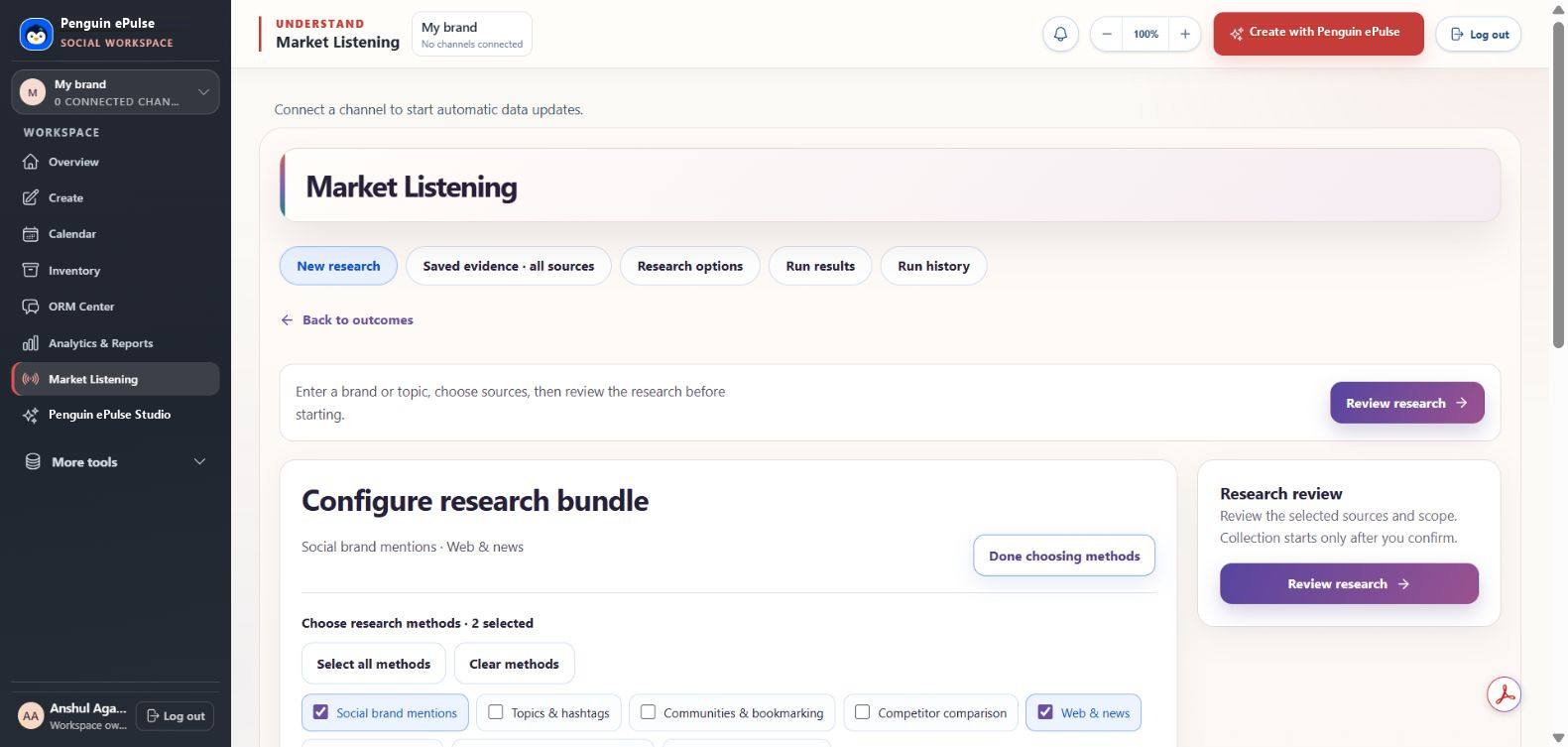
Where the Penguin ePulse features fit.
| Product surface | Role in this workflow |
|---|---|
| Market Listening | Build a scoped research brief and follow source links behind important findings. |
| AI Studio | Develop a working draft or explanation from available workspace context, with human review of the next action. |
| Create and Inventory | Prepare channel-specific drafts and keep working assets close to the content task. |
| Data Intelligence | Review configured research sources, collection scope and traceable records. Provider readiness and approved access determine available collection; source coverage is not exhaustive. |
Confirm the exact connected accounts, available actions and data before rollout. Research coverage depends on configured sources and provider access; some collection can carry provider costs. Human review and specialist handoffs follow your team's process.
Market Listening · Data Intelligence
Automobile owner-experience intelligence
Frame the model, market and ownership question in Market Listening. Review available public owner feedback and source records in Data Intelligence, removing similarly named models and duplicate examples. Distinguish communication themes from official recall or individual vehicle information.
- Frame the decision. Define the audience question, entities, geography and dates before collection.
- Review available evidence. Check configured sources and provider readiness, retain source links and remove duplicates or unrelated records.
- Make a reviewable decision. Separate observed patterns from interpretation, retain coverage limits and assign a clear next action.
Collection depends on configured sources, valid provider access and approved scope. Some research uses paid providers; confirm access and costs before a run. These examples do not promise complete market coverage or automatic collection.
Explore Market Listening and Data Intelligence →Measure the decision, not just the activity.
| Measure to review | What the evidence should show |
|---|---|
| Relevant-model coverage | Review the proportion of sampled items that match the selected models and market. |
| Supported question themes | Group recurring questions with source context and exclude duplicate or unrelated material. |
| Review actions | Track the education, service or specialist task proposed for each supported theme. |
Set your baseline from a comparable period and record the source for each measure. These are evaluation criteria, not measured Penguin ePulse customer results. Use approved external records when the business outcome sits outside the social workspace.
Questions about automotive social listening
How do Market Listening and Data Intelligence fit this workflow?
Frame the model, market and ownership question in Market Listening. Review available public owner feedback and source records in Data Intelligence, removing similarly named models and duplicate examples. Distinguish communication themes from official recall or individual vehicle information. Available collection depends on configured sources, valid provider access and approved scope.
Can social listening estimate a vehicle defect rate?
No. A selected online collection is not a vehicle population study and cannot establish a defect rate.
Can a brief compare different model years?
Only with explicit, matched scope and a careful review of the underlying sources. Keep model-year differences visible.
What is a useful automotive listening output?
A traceable set of owner questions, evidence limits and actions for the appropriate information, service or technical owner.
Sources and operating boundaries.
Vehicle safety questions require the appropriate specialist and official information. Social listening does not diagnose a defect or establish whether an individual vehicle is affected.
- NHTSA: official recall information — Official recall lookup; individual vehicle status requires an appropriate check.
External references support the information-handling or measurement context. They do not certify Penguin ePulse or independently verify its product capabilities.
Go deeper on the operating decisions.
More automobile use cases.



See this workflow with your team's context.
Bring an anonymized example and the account or research source you need. Walk through the source, the next action and the review afterward. The demo should establish which parts fit your current setup and which require another system or specialist.