Penguin ePulseBook a demo

The workflow comparison

Penguin ePulse
& Hootsuite.

Look beyond the publishing calendar. Follow the work from content to evidence.

Reviewed October 9, 2026 · Official sources linked throughout

Content and schedulingConnected conversationsAnalytics and reportsSource-linked researchStudio assistance

The practical difference

Choose the workflow.
Then choose the platform.

Both products bring social work into a shared environment. Penguin ePulse emphasizes scoped, source-linked research alongside content and connected conversations. Hootsuite documents established publishing, inbox, analytics and listening capabilities, with deeper automation and collaboration in higher plans.

Inside Penguin ePulse

Content.
Conversations.
Context.

Move from a draft to a customer question to the evidence behind your next decision. Keep the work in one social workspace.

See your workflow
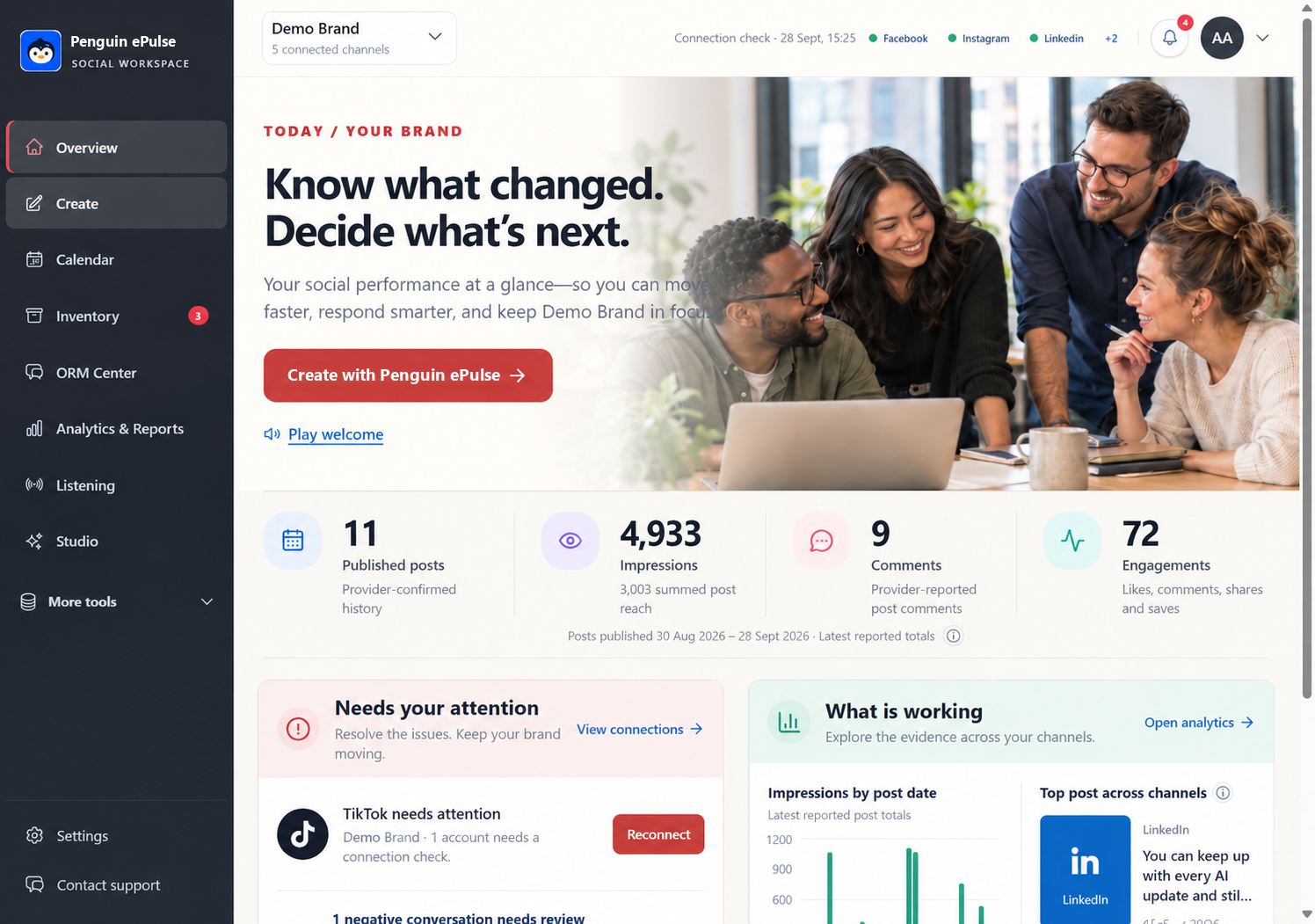
Penguin ePulse example workspace with content, conversations and performance context
Actual product view · Example workspace data

A closer look at our approach

Clear context.
Confident next steps.

01

Start with the question.

Define the topic, dates and source scope before collecting research. Make the brief fit the decision.

Explore Market Listening →
02

Keep the evidence close.

Follow direct source links behind findings. Review what the collection includes and what it leaves out.

See the research workflow →
03

Stay in control.

Studio works within available tools, permissions and action confirmations. Review the proposed next step.

Meet Studio →

Bring your campaign, your customer conversations and your research question into the same working context.

Where the decision gets specific

Look closer at the daily work.

Follow one campaign from start to finish.

Create the content in Penguin ePulse, plan it in Calendar, reuse the assets from Inventory, review connected conversations and inspect the report. Market Listening and Studio bring research and analysis into that working context. Hootsuite also documents publishing, inbox and analytics workflows; the table compares their supported capabilities.

Ask what listening actually includes.

Penguin ePulse makes the research question, dates and collection scope part of the brief. Hootsuite includes listening in its self-serve offering, with advanced sources and history at Enterprise level. Compare the returned sources and historical window rather than treating every mention count as equivalent.

Price the team workflow.

Hootsuite lists Standard, Professional, Advanced and Enterprise, with approvals in Advanced and SSO in Enterprise. Map your required routing, approval and reporting workflow to its plan before calculating the total. Penguin ePulse’s commercial quote and support matrix should answer the same requirements.

Keep the evidence in the review.

Penguin ePulse’s source-linked briefs are a useful reason to evaluate it for research-heavy social work. Hootsuite also offers listening, benchmarking and AI analysis. Request a representative finding from each and follow the evidence before deciding which workflow is clearer for your team.

Choose Penguin ePulse when content, connected conversations and traceable research need to work together. Compare Hootsuite’s plan and network scope against your requirements.

35 criteria · 2 platforms

Your daily workflow, connected.

35 core workflows across content, conversations, listening, analytics and AI. Select a symbol for its source.

✓ Supported workflow— Plan / scope varies✕ Core workflow not listed

Showing all 35 comparison criteria.

CapabilityPenguin ePulseContent · conversations · intelligenceHootsuitePublishing and social operations
Publishing
Draft creationKeep the intended account and version attached to the content.

Create workspace

Composer and AI captions

Content calendarA shared view should distinguish planned work from completed posts.

Calendar with content states

Calendar and list views

Post schedulingPlan a supported connected-account post for a chosen date and time.

Scheduled publishing for supported connections

Scheduled publishing

Media libraryCheck storage, version ownership and reuse of approved assets.

Inventory workspace

Canva and Adobe templates

Campaign content planningOrganize several campaign drafts and their calendar slots.

Multi-draft campaign and calendar planning

Whiteboard and campaign calendar

Timezone-aware schedulingKeep scheduled work aligned with the team’s selected timezone.

Brand-timezone calendar scheduling

Scheduled publishing and calendar

Care & ORM
Unified conversation inboxReview a real thread, its account and the next action together.

Connected-account ORM Center

Nest social inbox

Public comments and DMsRead and respond through supported connected-account actions.

Connected comments and private-message workflows

Comments and private messages

Conversation search and filtersFind the messages relevant to an account, date or issue.

Account, date, sentiment and risk filters

Inbox filters and conversation organization

Reply drafting assistancePrepare a response for human review before sending.

Contextual reply starters with human review

AI smart replies; plan varies

Conversation thread contextKeep a customer message connected to its original conversation.

Original post and conversation context

Inbox conversation history

Conversation and sentiment reportingBring collected conversation evidence into a useful report.

ORM reports with sentiment and source evidence

Engagement and service reporting

Listening
Brand and keyword monitoringDefine the query and make irrelevant results easy to identify.

Scoped market briefs

Listening included; depth varies

Public web researchSource access defines what a finding can reasonably represent.

Public web and search signals

Advanced sources: Enterprise

Sentiment analysisReview classified positive, neutral and negative conversation evidence.

Sentiment classification with evidence review

Listening sentiment; scope varies

Topic and theme discoveryA useful theme should lead back to the underlying evidence.

Research findings with links

Lumen trend discovery

Risk and negative-mention reviewReview negative sentiment and flagged issues before responding.

Negative sentiment and high-risk review

Listening and sentiment review

Competitor conversation researchCompare matched queries and time periods rather than raw totals.

Matched-scope research briefs

Competitor listening; plan limits

Research-to-content workflowUse a researched topic to inform the next content decision.

Market research alongside Create and Studio

Trend discovery to AI content

Analytics
Owned-account performanceKeep account identity and metric definitions visible.

Overview and Analytics & Reports

Cross-network analytics

Individual post performanceInspect results for a specific published post.

Post-level metrics and conversation evidence

Post-level performance

Paid and organic separationReview advertising and organic evidence in the appropriate reporting view.

Separate paid and organic reporting views

Paid and organic analytics

Period-over-period comparisonCompare equivalent metrics across selected reporting periods.

Date-window and reporting-period comparisons

Performance-period comparisons

Report exportsTake the loaded report evidence into a usable file.

CSV and JSON report exports

CSV, XLSX, PDF, PPT; plan varies

Report filters and drill-downsMove from the summary to the account, post or conversation detail.

Date, platform, source and sentiment drill-downs

Custom analytics views

AI & evidence
Content assistanceA generated draft still needs the correct brand and account context.

Workspace Studio assistant

AI captions and hashtags

Conversational assistantEvaluate how an answer uses your data and what it cannot access.

Natural-language Studio

Wisdom AI across plans

AI analysis and summariesRequire enough evidence to challenge a confident-sounding answer.

Scoped assistant responses

AI performance recommendations

Source evidence reviewTrace an important conclusion to its original context.

Direct research source links

Listening results; inspect outputs

Control over AI actionsAsk to see the confirmation step before a consequential action.

Permissions and action confirmations

Approval workflows: Advanced

Workspace & coverage
Connected-account selectionChoose the social account attached to the work.

Explicit connected-account selection

Connected profile selection

Brand and project organizationKeep the active brand or research project clear.

Brand-specific working context

Teams and social profiles

Source and coverage labelsUnderstand which collection supports the finding.

Provider, source and evidence labels

Listening sources and scope

Historical date filtersReview the stored evidence available within the chosen dates.

Stored-history and date-range review

Date-range reporting

Channel-specific viewsInspect channel-specific evidence without implying identical network access.

Platform-specific account and reporting views

Network-specific reports

The buying conversation

Compare the complete setup.

Prices below are published USD rates reviewed October 9, 2026; annual monthly equivalents require annual billing. Features, taxes, services and collection limits can change the total. Confirm a current quote.

Hootsuite

From $99

Standard $99, Professional $199, Advanced $399 per user/month on annual billing; Enterprise custom. Taxes and additional products may apply.

View pricing / product source

Bring the same requirements to every quote.

Specify users, social profiles, post formats, inbox sources, approval steps, listening queries, monthly volume, historical coverage, exports and onboarding. A seat-based publishing plan and a mention-based monitoring package are different purchases.

If you decide to switch

Plan a clean handover.

Keep a usable record.

Export the reports and content you need before ending a subscription. Confirm retention and export permissions. Historical metrics and listening archives may not transfer between providers.

Reconnect deliberately.

Reconnect accounts with the correct owner and permissions. Review post formats, drafts, scheduled items and time zones. Do not assume credentials or scheduled posts migrate automatically.

Rebuild the rules that matter.

Recreate listening queries, source scope, inbox ownership and approval paths. Ask the team which parts can be imported and which need manual configuration.

Validate one complete workflow.

Run a representative campaign before the handover: prepare a post, review a conversation, check a report and trace a research finding. Agree onboarding help and any fees in writing.

Before you decide

A few useful answers.

What is the difference between social media management and social listening?

Social media management organizes content, connected-account conversations and performance. Social listening examines a defined collection of conversations or market signals. Source coverage, permissions and historical access determine what each workflow can support.

Who is Penguin ePulse built for?

Penguin ePulse brings content creation, scheduling, connected conversations, analytics and source-linked research into a shared working context. Its industry use cases cover healthcare, pharma, IT, automobile, retail and agency teams.

Does Brand24 include a publishing calendar and customer-care inbox?

The reviewed Brand24 material focuses on monitoring, mentions, sentiment, alerts and intelligence. A publisher and a customer-care inbox are not listed as core workflows in those sources. Confirm current capabilities directly with Brand24.

Are Sprout Social Listening and Premium Analytics included in every plan?

Sprout lists Listening and Premium Analytics as separate add-ons from Standard upward. A publishing subscription alone should not be treated as the complete listening and advanced-analytics package.

How were these comparisons prepared?

Competitor findings use official product, pricing and help documentation reviewed October 9, 2026. Penguin ePulse descriptions use product implementation, public material and saved product views. This is a vendor-authored comparison, not a hands-on audit of every competing subscription. Confirm plan-specific details in a demo.

Product sources and scope.

Reviewed October 9, 2026. Published capability is different from a tested entitlement. Network actions, source coverage and subscription entitlements vary by platform. The matrix compares the named workflows; it does not imply unlimited access. Penguin ePulse is the author of this comparison.

Third-party names identify the products being compared. No affiliation or endorsement is implied.

Go deeper

One platform at a time.

Also researching Statusbrew? Read the existing workflow comparison →

Bring one campaign.
See the whole workflow.

Test the draft, the conversation, the report and the research question your team needs to answer.

Book your walkthrough →