
Agency · Market Listening
Build competitive research a client can challenge
Agency social listening turns a client research question into a scoped brief with inspectable evidence. Penguin ePulse Market Listening supports source-linked research. Define competitors, topics, dates and available sources, then separate observation, verified vendor facts and interpretation before recommending a creative or positioning change to the client.

Illustrative industry scenes · Anonymous workflows, not customer stories.
Illustrative example · Agency
Agency social listening, made visible.
Separate a recurring theme from a claim that needs stronger evidence. Switch the sample period to see the counts and the mix together.
Source-linked research over time
Weekly counts · 6-week example
Select a chart point to inspect the sample counts.
Example mix
Categories in the illustrative sample
View the 6-week example data
| Week | Source items sampled | Traceable items |
|---|---|---|
| 1 | 38 | 26 |
| 2 | 34 | 24 |
| 3 | 30 | 23 |
| 4 | 39 | 31 |
| 5 | 35 | 24 |
| 6 | 44 | 32 |
Source-linked research over time
Weekly counts · 12-week example
Select a chart point to inspect the sample counts.
Example mix
Categories in the illustrative sample
View the 12-week example data
| Week | Source items sampled | Traceable items |
|---|---|---|
| 1 | 38 | 26 |
| 2 | 34 | 24 |
| 3 | 30 | 23 |
| 4 | 39 | 31 |
| 5 | 35 | 24 |
| 6 | 44 | 32 |
| 7 | 40 | 30 |
| 8 | 49 | 39 |
| 9 | 45 | 31 |
| 10 | 54 | 39 |
| 11 | 50 | 38 |
| 12 | 59 | 47 |
Illustrative example numbers, not measured Penguin ePulse performance or customer results. Replace these with your approved records when evaluating the workflow.
Showing 6 weeks of illustrative example data.
The situation your team needs to change.
A client asks why a competitor seems to own the conversation. The request could refer to posting frequency, a campaign theme or buyer discussion. A broad mention count will not resolve that ambiguity. The agency needs to define the actual decision and build a brief the client can inspect without accepting an unexplained AI summary.
A broad competitor total is presented as strategy without defining sources or the client decision.
A matched research brief links the evidence to a creative or positioning hypothesis and states what it cannot establish.
How to approach agency social listening.
Clarify the decision and matched scope
Choose a question such as which objections each competitor addresses in public content. Define the entities, period, markets and available sources. Use comparable scope across competitors and document known coverage gaps before collecting or interpreting totals.
Review the sources behind the finding
Follow links for the central examples, inspect a relevance sample and remove duplicate or unrelated material. Distinguish competitor statements from buyer comments and agency interpretation. Verify material product claims using current official documentation rather than repeating a social assertion.
Present an evidence-led creative hypothesis
Recommend a content angle or positioning test with supporting examples and stated limits. Include a counterexample or alternative explanation where relevant. Agree with the client what would support the test before turning the finding into a campaign promise or competitive claim.
Inside the workspace
The product behind the workflow.
Connect the operating question to the relevant Penguin ePulse features. Use your own account and sources to evaluate the next step.
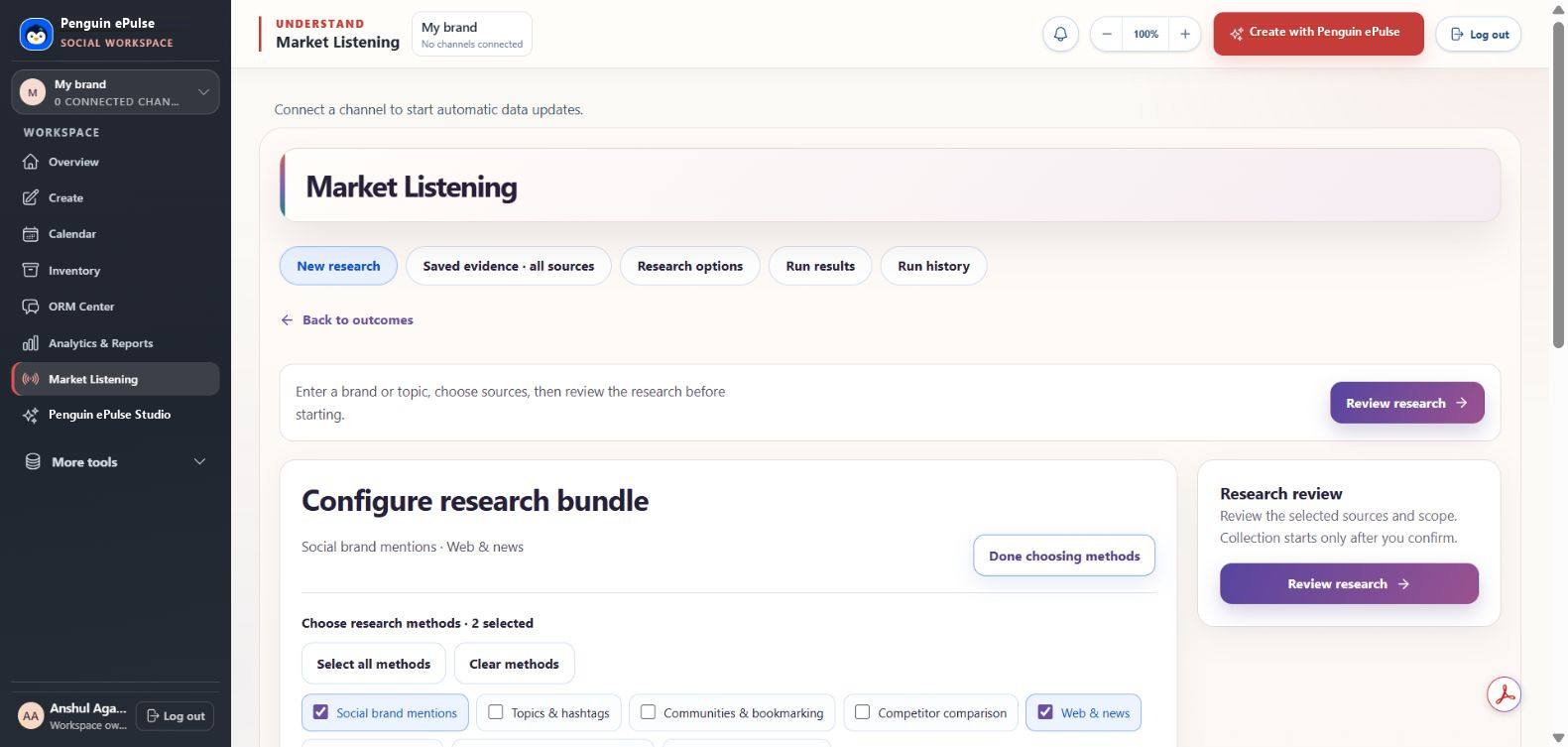
Where the Penguin ePulse features fit.
| Product surface | Role in this workflow |
|---|---|
| Market Listening | Build a scoped research brief and follow source links behind important findings. |
| AI Studio | Develop a working draft or explanation from available workspace context, with human review of the next action. |
| Create and Inventory | Prepare channel-specific drafts and keep working assets close to the content task. |
| Data Intelligence | Review configured research sources, collection scope and traceable records. Provider readiness and approved access determine available collection; source coverage is not exhaustive. |
Confirm the exact connected accounts, available actions and data before rollout. Research coverage depends on configured sources and provider access; some collection can carry provider costs. Human review and specialist handoffs follow your team's process.
Market Listening · Data Intelligence
Agency market and competitive intelligence
Frame a client decision in Market Listening, then use Data Intelligence to review available competitor and public-market sources. Match entities, dates and source scope before comparison. Give the client inspectable examples, alternative explanations and a testable creative hypothesis.
- Frame the decision. Define the audience question, entities, geography and dates before collection.
- Review available evidence. Check configured sources and provider readiness, retain source links and remove duplicates or unrelated records.
- Make a reviewable decision. Separate observed patterns from interpretation, retain coverage limits and assign a clear next action.
Collection depends on configured sources, valid provider access and approved scope. Some research uses paid providers; confirm access and costs before a run. These examples do not promise complete market coverage or automatic collection.
Explore Market Listening and Data Intelligence →Measure the decision, not just the activity.
| Measure to review | What the evidence should show |
|---|---|
| Matched research coverage | Check entities, sources and periods before comparing findings. |
| Inspectable evidence | Review whether the central conclusion has accessible source examples and an explicit interpretation. |
| Client tests agreed | Track which creative or positioning hypotheses progress to an owned, measurable test. |
Set your baseline from a comparable period and record the source for each measure. These are evaluation criteria, not measured Penguin ePulse customer results. Use approved external records when the business outcome sits outside the social workspace.
Questions about agency social listening
How do Market Listening and Data Intelligence fit this workflow?
Frame a client decision in Market Listening, then use Data Intelligence to review available competitor and public-market sources. Match entities, dates and source scope before comparison. Give the client inspectable examples, alternative explanations and a testable creative hypothesis. Available collection depends on configured sources, valid provider access and approved scope.
Can a listening brief prove a competitor leads the market?
No. A scoped conversation collection does not establish market share, revenue or total category demand.
Can clients inspect the evidence?
The documented Market Listening workflow supports source-linked briefs. Confirm access to the particular sources required for the client task.
Should every competitor claim be repeated?
No. Verify material capability or performance statements against reliable current evidence and retain uncertainty where verification is missing.
Sources and operating boundaries.
Validate account access, client boundaries and handoffs with representative users before rollout. The examples do not claim unrestricted white-labeling, automated routing or support for every channel.
- FTC: social endorsement disclosures — Guidance on disclosing relevant relationships in social endorsements.
External references support the information-handling or measurement context. They do not certify Penguin ePulse or independently verify its product capabilities.
Go deeper on the operating decisions.
More agency use cases.



See this workflow with your team's context.
Bring an anonymized example and the account or research source you need. Walk through the source, the next action and the review afterward. The demo should establish which parts fit your current setup and which require another system or specialist.