
Penguin ePulse insights
Better questions.
Clearer social decisions.Page 5 of 7
100 practical guides to social analytics, brand listening, reputation management and marketing operations.
Showing 61–75 of 100 guides · Page 5 of 7

A Social Media Inbox Workflow That Keeps Source Context Visible
Build a social inbox workflow that preserves source identity, conversation context, routing, reply authority, and verified delivery state.
Comment Moderation: Create Rules That Your Team Can Apply Consistently
Create comment moderation rules based on observable behavior, proportional actions, context review, and consistent human decisions.
Social Response Time: Define the Clock Before Setting an SLA
Define social response time with explicit start and stop events, business hours, collection delays, exclusions, and separate resolution measures.
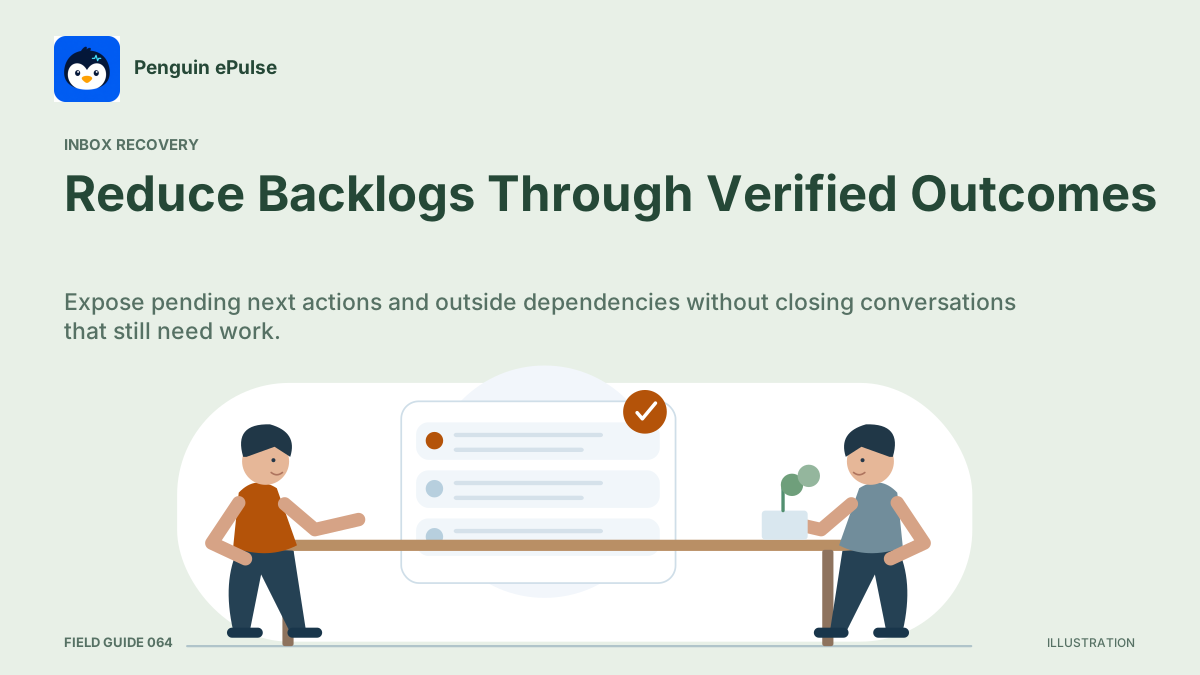
Reduce a Social Inbox Backlog Without Closing Unresolved Conversations
Reduce a social inbox backlog through a verified inventory, risk and age triage, accepted ownership, limited work in progress, and honest closure.
Brand Voice in Customer Replies: Write Clearly Under Pressure
Apply brand voice in customer replies through clear answers, appropriate acknowledgment, verified next steps, and situation-sensitive tone.

Social Customer Service Handoffs: Transfer Context, Not Just a Link
Transfer social customer service cases with accepted ownership, source context, prior promises, necessary evidence, and a clear communication plan.
Preserve Social Conversation Context Before You Draft the Reply
Preserve social conversation context through parent content, relevant history, source identity, missing-record checks, and disciplined summaries.
Build a Community FAQ Workflow From Repeated Customer Questions
Turn repeated social customer questions into approved community answers with intent grouping, context, escalation rules and a maintained knowledge source.

Route Social Conversations With Clear Owners and Exceptions
Create social conversation routing rules with accountable owners, priority criteria, secure handoffs and explicit handling for unmatched or sensitive conversations.

Measure Social Conversation Resolution Separately From Response Speed
Define resolution metrics that distinguish first response, customer wait, reopened cases and confirmed closure, then analyze them by comparable conversation cohorts.

Competitor Social Media Analytics: Make Comparisons You Can Defend
Use competitor social media analytics with a clear question, comparable periods, observable metrics, denominator checks, and transparent source limits.

Build a Competitor Social Dataset With Transparent Coverage
Build a competitor social dataset with stable identifiers, observation dates, coverage checks and explicit missing values before calculating benchmarks.
Share of Engagement: A Useful Comparison With Important Limits
Calculate share of engagement within a declared peer set, matching interaction definitions and explaining the effects of posting volume and missing data.

Brand Health Measurement: Combine Signals Without Hiding the Method
Measure brand health through separate awareness, trust, conversation and behavior signals, with transparent methods and limits on composite scores.
Track a Competitor Campaign Without Assuming Access to Its Results
Track a competitor campaign through observable assets, messages and timing, while keeping spend, targeting, conversion and commercial results unresolved.
No matching guides.